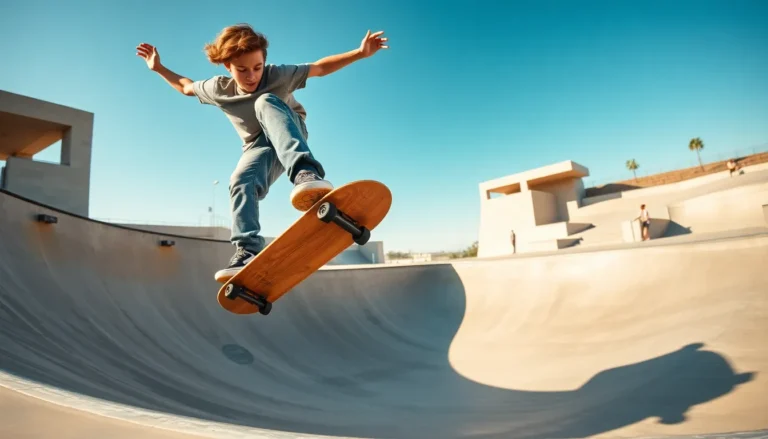
Skateboarding examples range from simple ollies to gravity-defying aerial maneuvers. Whether someone just stepped on a board or has been skating for years, there’s always a new trick to learn. This guide breaks down skateboarding examples across all skill levels, from beginner-friendly moves to advanced techniques that pros use in competitions. Readers will discover different tricks, styles, and disciplines that make skateboarding one of the most creative and expressive sports on the planet.
Table of Contents
ToggleKey Takeaways
- The ollie is the foundational trick that unlocks nearly all other skateboarding examples, making it essential for beginners to master first.
- Skateboarding examples range from beginner moves like kickturns and manuals to advanced tricks like tre flips and vert aerials.
- Intermediate tricks such as kickflips, heelflips, and 50-50 grinds build the coordination needed for more complex maneuvers.
- Different skateboarding disciplines—street, vert, park, and freestyle—each offer unique tricks, terrain, and creative expression.
- Park skating became an Olympic event in 2021, showcasing skateboarding examples to a worldwide audience.
- Skateboarding isn’t just about tricks—downhill riding and cruising highlight the sport’s versatility for speed and transportation.
Basic Skateboarding Tricks for Beginners
Every skater starts somewhere. These foundational skateboarding examples build the skills needed for more advanced moves later.
The Ollie
The ollie is the most important trick in skateboarding. It’s the foundation for almost every other trick. To perform an ollie, a skater snaps the tail of the board down while jumping and sliding the front foot forward. This motion lifts the board into the air. Mastering the ollie takes practice, but it opens the door to countless other skateboarding examples.
The Kickturn
A kickturn teaches balance and board control. The skater shifts weight to the back foot, lifts the front wheels off the ground, and pivots the board 90 to 180 degrees. Kickturns work on flat ground or ramps. They’re essential for changing direction and setting up other tricks.
The Manual
A manual is like a wheelie on a skateboard. The skater balances on the back wheels while rolling forward. This trick improves balance and can be linked with other skateboarding examples to create longer trick combinations.
The Shuvit
The shuvit spins the board 180 degrees beneath the skater’s feet without the body rotating. It’s performed by scooping the back foot backward while the front foot guides the board. The shuvit teaches foot coordination and board manipulation. Once comfortable with the shuvit, skaters can progress to pop shuvits and other variations.
Intermediate Skateboarding Techniques
After mastering the basics, skaters can tackle these intermediate skateboarding examples. These tricks require better timing, coordination, and commitment.
The Kickflip
The kickflip is one of the most iconic skateboarding examples. It combines an ollie with a flick of the front foot that spins the board along its length. The board rotates 360 degrees before the skater catches it and lands. Landing a first kickflip is a milestone for most skaters.
The Heelflip
The heelflip is the kickflip’s counterpart. Instead of flicking with the toes, the skater uses the heel to spin the board in the opposite direction. Heelflips feel different from kickflips, and most skaters find one easier than the other.
The 50-50 Grind
Grinding introduces skaters to obstacles. A 50-50 grind involves ollieing onto a rail or ledge and sliding along it with both trucks. This trick teaches skaters to commit to obstacles and maintain balance while moving. It’s one of the most accessible skateboarding examples for learning grinds.
The Boardslide
A boardslide requires the skater to ollie onto an obstacle and slide perpendicular to it, with the board’s underside grinding along the surface. Boardslides look stylish and feel satisfying once dialed in. They also teach skaters to approach obstacles at angles.
The Frontside 180
This trick combines an ollie with a 180-degree body and board rotation. The skater turns frontside, meaning the chest faces forward during the rotation. Frontside 180s teach aerial body control and set up more advanced rotational tricks.
Advanced Skateboarding Tricks and Styles
Advanced skateboarding examples push physical and creative limits. These tricks take years to master and showcase individual style.
The Tre Flip (360 Flip)
The tre flip combines a kickflip with a 360-degree shuvit. The board flips and spins simultaneously while the skater stays airborne. It’s one of the most popular advanced skateboarding examples because it looks incredible when done cleanly.
The Hardflip
A hardflip merges a kickflip with a frontside pop shuvit. The board flips vertically while rotating. This trick requires precise foot positioning and timing. Many skaters consider it one of the harder flip tricks to learn.
The Bluntslide
Bluntslides are advanced grinds where the skater slides on the tail of the board while it’s positioned vertically on the obstacle. Getting into and out of a bluntslide demands excellent balance and board control.
Gap Tricks
Gapping involves performing skateboarding examples over large distances or obstacles. Skaters ollie or kickflip over stairs, gaps between ledges, or other features. Gap tricks require speed, commitment, and confidence.
Vert Skating Aerials
Vert skaters perform tricks in halfpipes and bowls. Aerials like the McTwist (a 540-degree rotation with a flip) and the 900 showcase the highest level of skateboarding. Tony Hawk landed the first 900 in competition in 1999, and skaters continue to push aerial limits today.
Different Skateboarding Disciplines
Skateboarding examples vary depending on the discipline. Each style has its own tricks, terrain, and culture.
Street Skating
Street skating uses urban environments as obstacles. Stairs, handrails, ledges, benches, and gaps become features for tricks. Street skaters adapt to their surroundings and often create unique skateboarding examples based on what they find. This discipline dominates modern skateboarding culture and competitions like Street League.
Vert Skating
Vert skating focuses on halfpipes and large ramps. Skaters gain speed by pumping up and down transitions, then launch into the air for tricks. Vert skating emphasizes amplitude (height) and technical aerial maneuvers. It was the dominant form of skateboarding in the 1980s and remains popular today.
Park Skating
Park skating blends street and vert elements in purpose-built skateparks. Bowls, rails, stairs, and ledges combine in one space. Park skaters flow through courses, linking tricks together. Park skating became an Olympic event in 2021, introducing skateboarding examples to a global audience.
Freestyle Skating
Freestyle skating involves flatground tricks performed in a routine, often to music. Skaters balance, spin, and flip the board using technical footwork. Freestyle was popular in skateboarding’s early days and has seen a recent revival.
Downhill and Cruising
Not all skateboarding examples involve tricks. Downhill skating focuses on speed, with riders bombing hills on longboards. Cruising emphasizes transportation and relaxation. Both styles show skateboarding’s versatility beyond technical tricks.